The design engineer of all motors and electronic products that need to use fans for heat dissipation must decide the air volume required for heat dissipation of a specific system, and the required air volume depends on understanding the power consumption of the system and whether it can take away enough heat to prevent the system from overheating. Facts show that the service life of the system will be reduced due to the lack of cooling system, so the design engineer should also understand that the sales volume and price of the system may decline because the service life of the system does not meet the expectations of users.
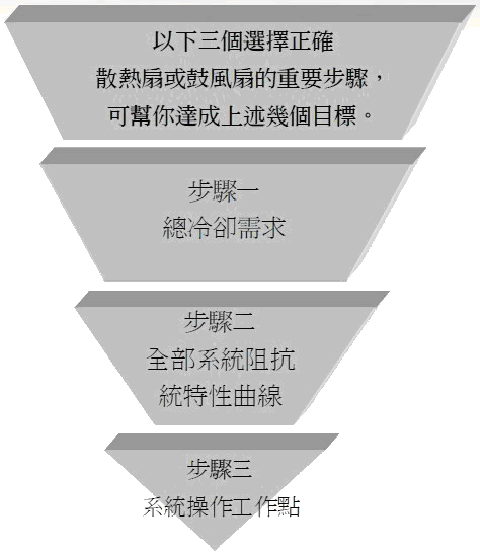
To select the correct ventilation components, the following objectives must be considered:
● best air flow efficiency
● minimum suitable size
● minimum noise
● minimum power consumption
● maximum reliability service life
● reasonable total cost
Step 1: total cooling demand
First, three key factors must be understood to obtain the total cooling demand:
● heat that must be converted (i.e. temperature difference DT)
● wattage to offset converted heat (W)
● air volume required to remove heat (CFM)
The total cooling demand is very important for the effective operation of the system. Efficient system operation must provide ideal operating conditions, so that all components in the system can play the maximum function and the longest service life. The following methods can be used to select general fan motors:
● calculate the heat generated inside the equipment.
● determine the allowable temperature range inside the equipment.
● calculate the required air volume from the equation.
● estimate the system impedance for the equipment.
● select the required fan according to the characteristic curve or specification in the catalogue.
If the internal heat dissipation of the system equipment and the allowable total temperature rise are known, the air volume required for cooling the equipment can be obtained. The following is the basic heat conversion equation:
H=Cp×W×ΔT
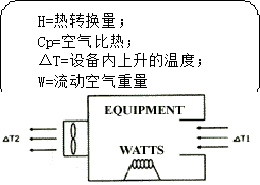

H= heat conversion capacity;
Cp= specific heat of air;
Δ T= rising temperature in the equipment;
W= weight of flowing air
We know that w=cfm × D where d= air density, after substitution, we get
Q(CFM)= Q / (Cp × D × △T)
Then from the conversion factors and the specific heat and density of the air entering the sea level, the following heat dissipation equation can be obtained:
CFM=3160 × KW / △ f
Then the following equation is obtained:
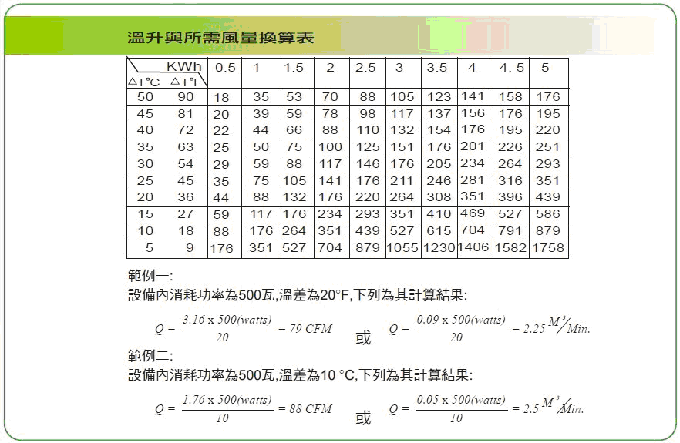
Q(CFM)=3.16 × P/ △Tf = 1.76 × P/ △Tc
Q(M3/Min) = 0.09 × P/△Tf = 0.05 × P/ △Tc
Q: Air volume required for cooling
P: Internal heat dissipation of equipment (i.e. electric power consumed by equipment)
Tf: allowable internal temperature rise (Fahrenheit)
Tc: allowable internal temperature rise (Celsius)
DT = temperature difference between dt1 and DT2
Step 2: all system impedance / system characteristic curves
When air flows, the airflow will encounter the obstruction of internal parts of the system in its flow path, and its impedance will restrict the free flow of air. The change in pressure is the measured static pressure, expressed in British time water column.
In order to confirm the cooling wattage of each slot, the system designer or manufacturer must not only have the effective fan characteristic curve of the fan to determine its maximum air volume, but also know the wind resistance curve of the system. Parts inside the system will cause the loss of wind pressure. This loss changes due to the air volume, which is called the system impedance.
The system characteristic curve is defined as follows:
DP=KQn
K= system specific coefficient
Q= air volume (cubic feet)
N= turbulence factor, 1
In case of flat air flow, n=1
In turbulent flow, n=2
Step 3: system operation work point
The intersection of the system characteristic curve and the fan characteristic curve is called the system operation point, which is the best action point of the fan.
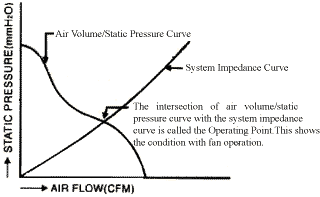
When the operating point is at the operating point, the change slope of the fan characteristic curve is the smallest, and the change rate of the system characteristic curve is the lowest. Pay attention to the static efficiency (air volume) of the fan at this time × Wind pressure ÷ power consumption) is optimized.
The following items shall be considered in the design:
1. Keep the air flow as unobstructed as possible, and keep the air inlet and outlet unblocked.
2. Guide the air flow vertically through the system to ensure smooth air flow and improve the cooling efficiency.
3. If it is necessary to install an air filter screen, the increased air flow resistance should be considered.


 Collection



 Official account
 Applet
 Hu ICP Bei No. 2021000466-1 snapshot optimization technical support: China Southern Netcom
 Message
 One touch dialing